NutriAsia is turning a simple refill station into a blueprint for affordable, everyday sustainability in the Philippines
By KATHERINE L. MAGSANOC
For decades, the Filipino “tingi” culture has shaped the way millions of households shop.
Sachets have made everyday essentials affordable and accessible, but they have also become one of the country’s biggest environmental challenges.
Rather than asking consumers to abandon a deeply ingrained habit, NutriAsia is exploring a different approach: making sustainable choices just as practical, convenient, and economical.
Its Bring Your Own Bote (BYOB) initiative, which began as a small refill station experiment in Bonifacio Global City, has evolved into a nationwide collaboration involving government agencies, communities, sustainability advocates, and sari-sari store owners.
Today, the program is positioning refilling not simply as an environmental campaign, but as a viable business model that could reshape how everyday consumer goods are sold in the Philippines.
FROM PILOT PROJECT TO MOVEMENT
When NutriAsia introduced its first BYOB refill station in 2019, the objective was modest: demonstrate that consumers would be willing to refill reusable bottles instead of purchasing single-use sachets.
The six-week activation generated enough public interest that it continued operating until the pandemic temporarily halted the initiative.
The response revealed something important: many consumers were willing to adopt refilling when it was easy and affordable.
That insight laid the foundation for BYOB 2.0, a broader initiative designed not merely to raise awareness, but to build an ecosystem where refilling becomes part of everyday commerce.
PARTNERSHIPS THAT MATTER
Unlike its first iteration, BYOB 2.0 operates through collaboration rather than a single corporate effort.
The initiative is supported by Plastic Reboot, funded by the Global Environment Facility and managed locally by PCX Solutions together with the Department of Environment and Natural Resources (DENR). It also brings together organizations such as ReCirCa, Salin.Ph, Tingi Station, local government units and community partners.
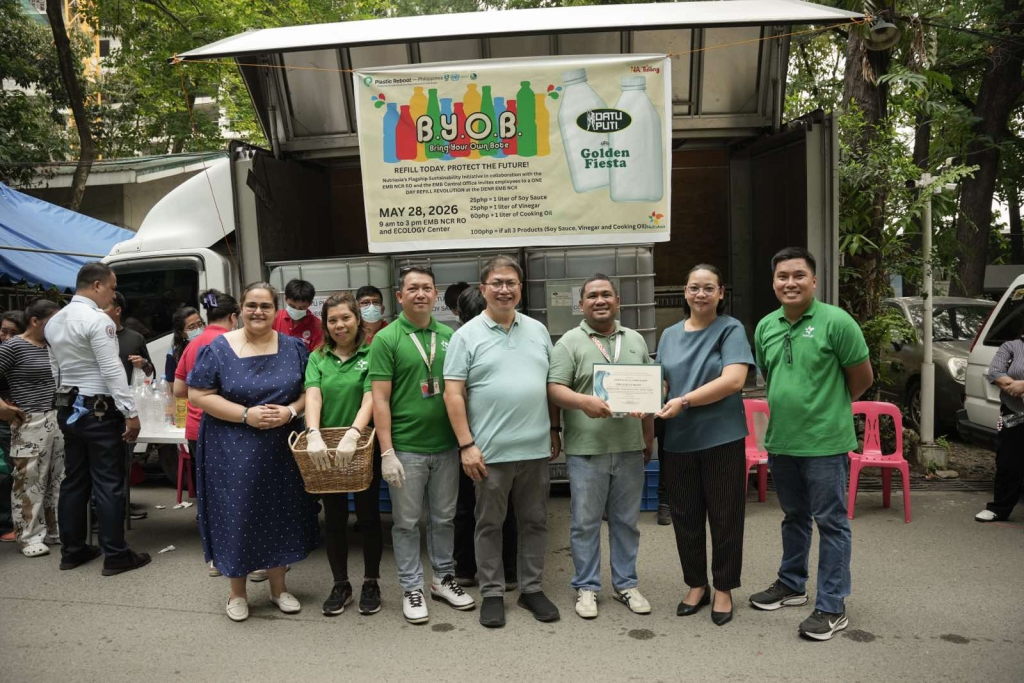
The program now operates across multiple models — from Refillka in Taguig, which aims to integrate refilling into thousands of sari-sari stores; to Salin Swap in Cabuyao’s closed-loop container system, community-based refill hubs in Baguio; and the BYOB Refill Revolution Truck that brings refill services directly to DENR regional offices.
For Athalie Reyes, Plastic Reboot Philippines project manager, NutriAsia’s participation demonstrates how collaboration across sectors can accelerate upstream solutions to the country’s growing plastic waste challenge.
MAKING SUSTAINABILITY AFFORDABLE
Perhaps the initiative’s strongest proposition is that sustainability and affordability do not have to compete.
Instead of presenting refilling as an environmental sacrifice, NutriAsia offers bulk-dispensed products priced below their sachet equivalents, creating immediate savings for consumers while reducing packaging waste.
“When we started the BYOB project in 2019, we simply wanted to be part of the solution by showing consumers that refilling can be done,” says James Lim, NutriAsia Corporate Marketing Head.
“With BYOB 2.0, we are taking our commitment to the next level and walking the talk; pushing refilling as a sustainable model for making our products more accessible, affordable and available.”
The company is likewise developing systems to measure sachet avoidance, plastic diversion, and other circular economy metrics, allowing the initiative’s environmental impact to be tracked through measurable data instead of broad sustainability claims.
SHAPING WHAT’S NEXT
Beyond the refill stations themselves, NutriAsia is also contributing to conversations that may influence the future of refilling in the Philippines.
Working alongside ReCirCa, the Food and Drug Administration (FDA), the Department of Science and Technology (DOST), DENR-Environmental Management Bureau (EMB), and the United Nations Industrial Development Organization (UNIDO), the company is participating in the development of national refilling guidelines.
The ongoing six-month field study in Taguig seeks to establish standards that local government units can eventually adopt in crafting their own policies.
Corporate Affairs Manager Wally Panganiban believes these standards will help ensure consumer safety while providing participating businesses with a credible regulatory framework for refilling initiatives.
As companies continue to rethink how sustainability can be embedded into everyday business, NutriAsia’s BYOB journey suggests that lasting change may not always begin with sweeping mandates.
Sometimes, it starts with something as familiar as bringing a bottle from home — and building an ecosystem that makes refilling the easiest choice of all.